Space, sacred geometry, new directions of science and images of the Man of the Future are collected in a single visual atlas. Scientific topics, cultural symbols and artistic scenarios are marked separately.
The four directions help to consider it on different scales: from space and language of forms to interdisciplinary knowledge and human life. These are author scripts and visual studies open to discussion.
Interactive Infographics
How the image becomes The overall plan.
Select the direction and link of the route. The scheme will explain what role each project can play in the development of the idea.
01
Space / Memory
Save
Preserve observational histories, maps, research evidence, and the origin of each material.
The diagram shows the semantic connections and the possible order of work. The specific project, participants and conditions are discussed separately.
01Visual Script · Space
01 / Scale of thinking
Space
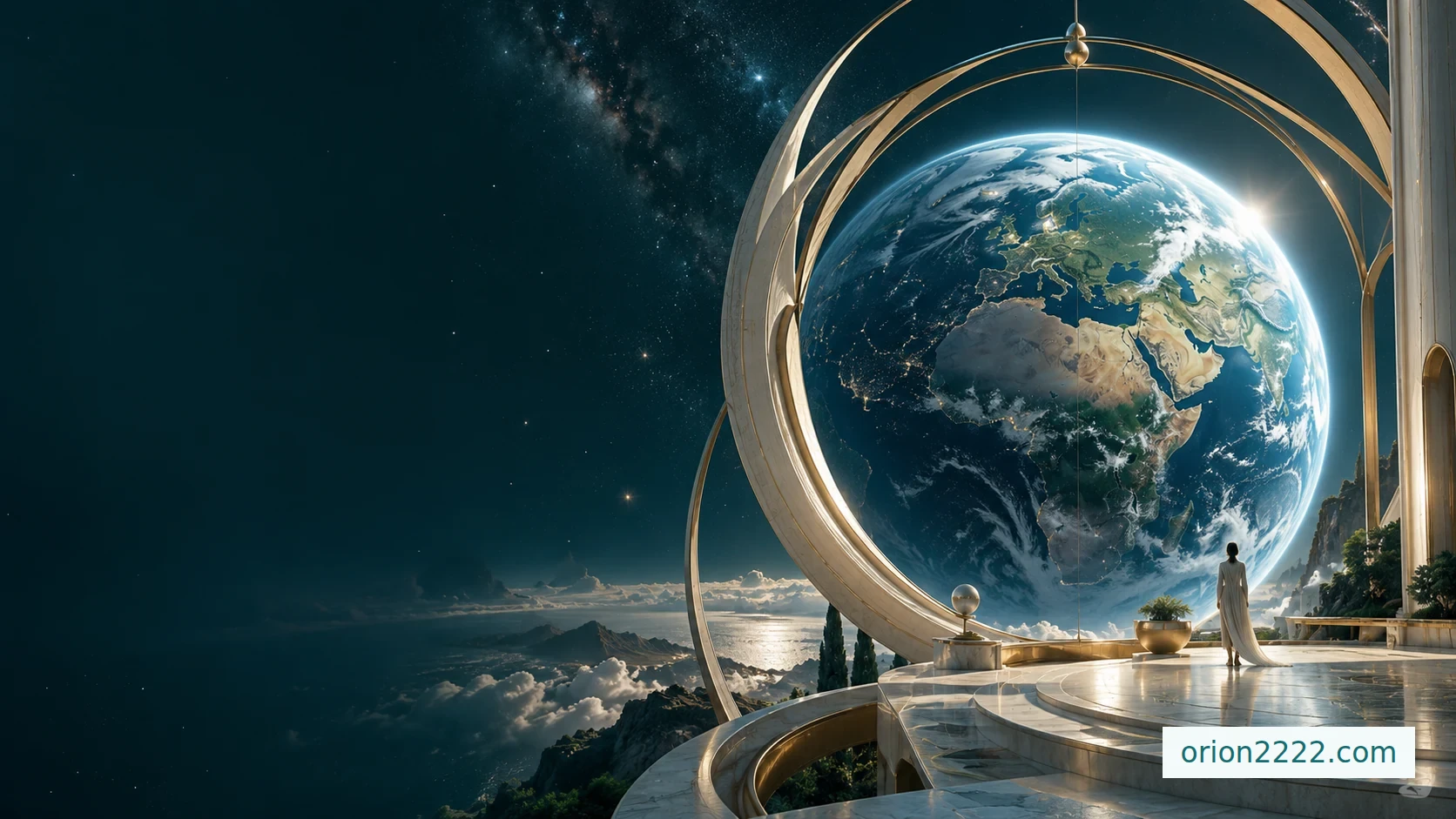
From the view of the Earth from the side - to the culture of the long horizon. Space is becoming an image of exploration, careful attitude to the planet and cooperation.
01
Planetary Thinking
Consider water, landscapes, cities, and human communities as connected parts of a shared world.
02
Culture of research
Connect questions, observations, models and open conversation about the boundaries of knowledge.
03
The Long Horizon
Discuss solutions through their implications for future generations, not just for the present moment.
Relationship to Heritage
Research stories, sky maps, observation diaries, and cosmic images of culture can become archive materials — along with authorship and context.
Circle, symmetry, rhythm and repetition are the material for visual exploration. Here, sacred geometry is seen as a cultural and artistic language.
01
Form and rhythm
Explore circles, grids, proportions, and symmetry in composition, graphics, and spatial models.
02
Cultural context
Compare ornaments and symbols, preserving the differences of tradition, authorship and history of origin.
03
Visual Thinking
Use geometry for understandable schemes: from the structure of the collection to the links between the directions of the project.
Relationship to Heritage
Sketches, ornaments, models and author's interpretations can be described in the Archive as works and cultural evidence. Scientific evidence requires a separate justification.
Not a list of announced discoveries, but a space of questions at the intersection of knowledge about nature, man, data and complex systems.
01
Living Systems and Environment
Consider the links between nature observation, engineering design, and habitat care.
02
Data and cultural memory
Discuss how to describe, compare, and store knowledge so that the source and meaning remain distinguishable.
03
Man and Technology
Explore learning, collaboration and responsibility when creating new tools.
Relationship to Heritage
It is not just the results that matter in the archive: questions, methods, inputs, and constraints help to understand how knowledge arose and what remains to be tested.
ORION 22:22Atlas of the future.Four directions. A single horizon.
Futurological presentation
Big idea. Clear consistency.
A brief presentation connects the cosmos, the language of geometry, research directions and the image of the person of the future with the overall architecture of ORION.
Artistic scenarios for discussion. The presentation does not describe the existing scientific programs and does not set a time frame for their implementation.
From image to material
Create a continuation in the language of Orion.
Gallery, texts, visual directions and materials for new publications - in the content studio.
Films 2–4 October 2026: author's ideas, research questions and images of the future.
1:00
Living Russia — Film One: The Polytechnic Museum
An artistic vision of a future museum for the Living Russia programme: culture, science and creativity shared across generations. This is neither the existing Moscow museum nor an approved project.