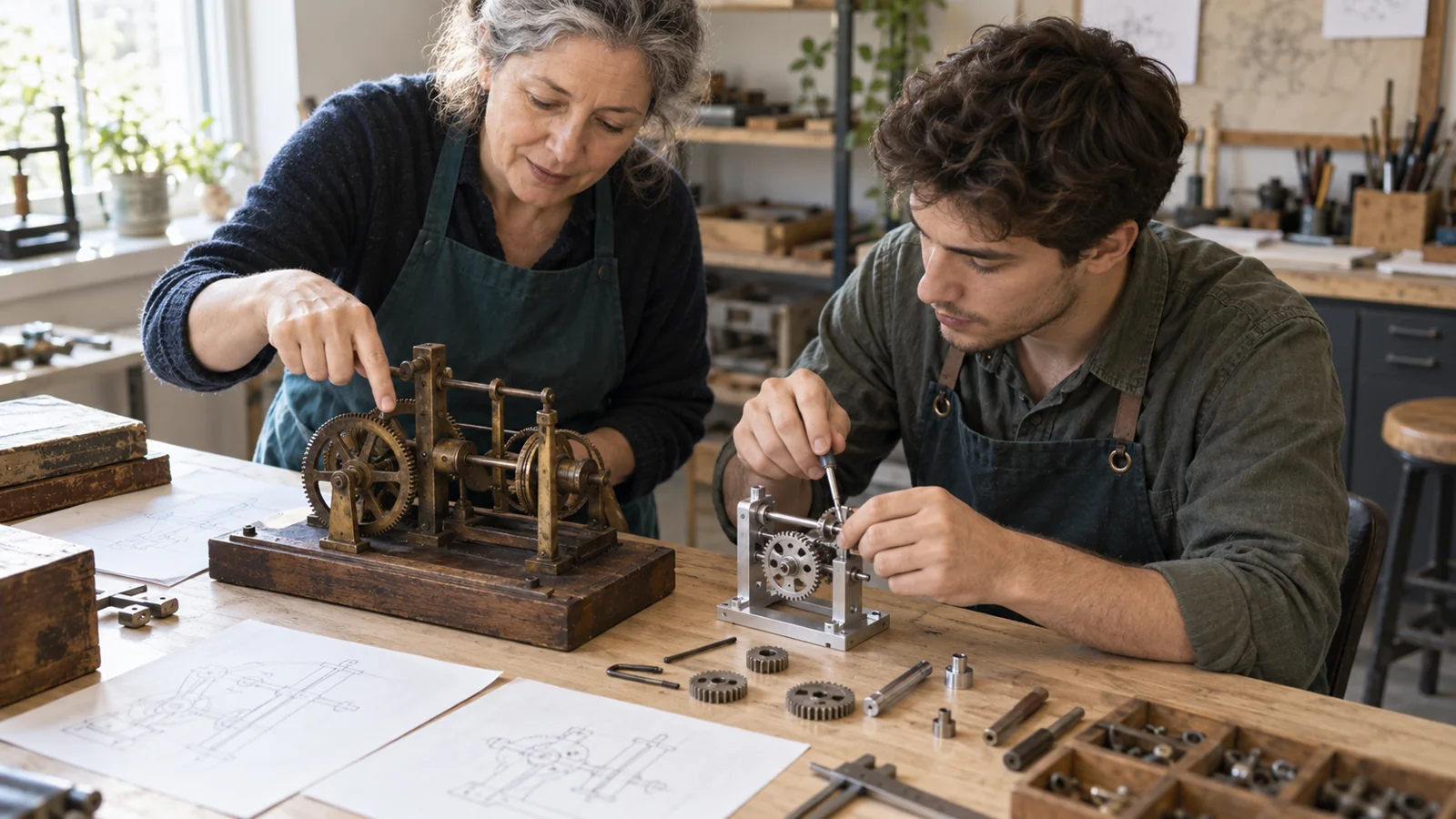
The technical item stores more than the release date and the name of the designer. It combines available materials, methods of calculation, organization of work and ideas about what a person needs. If you only show the appearance of the device, these connections remain invisible. If you restore its task, the museum object becomes the beginning of a conversation about how engineering decisions are made.
Start with a question to the subject
The author's concept "Technological Face of Russia" offers to talk about technology through the problem, principle, engineering solution, production, influence and further horizon. This is a useful editorial sequence: it links the history of a thing to the system in which the thing worked. In the source, this approach is proposed for the Polytechnic Museum; here we consider it as the basis of educational material, without claiming to accept the concept of a museum. Initial presentation, slides 5 and 13.
For the first study, one question is enough: why is the device designed in this way? The answer requires a comparison of alternatives. For example, it is possible to find out what task the computing device solved, what limited its accuracy and what the operator had to do. This analysis returns to the history of technology the work of people, and the student gives the opportunity to track the progress of the decision instead of remembering the finished result.
Connect source and own observation
On the official website of the Polytechnic Museum, thematic groups and digitized items of the collection are published. Among them are computing, transport and energy. These materials allow you to start acquaintance with a particular object and then clarify its context on related documents. The very fact of having a digital description does not yet answer all research questions: information should be read taking into account their composition and origin. Museum collection.
The proposed training route consists of small actions. First, the participant records what is known from the source. Then selects its own hypothesis about the device or application. After that, looking for a way to check: additional description, calculation, safe model or specialist consultation. In the final note, it is important to maintain the boundary between the source's message, observation and the author's conclusion.
Engineering culture begins where a person can explain their choices and show what they are based on.
Making Learning a Continuation of History
In the educational section of the museum, materials for teachers and descriptions of educational projects are available. They can be used as a starting point for self-study; the specific format of classes and conditions of participation should be clarified with the organizer himself. Educational resources of the Polytechnic Museum.
On the ORION portal, such a route can end with a small passport of research work: the object, question, sources, the course of verification, the result and the next step. This is an offer to work with material, not an entry to an existing educational program. A good result does not necessarily look like a new device. They can be an exact explanation of the principle, a contradiction discovered or an honestly formulated question for which there is still insufficient data.
Passing the knowledge relay
The next group receives not only the finished text, but also the history of its verification. It can clarify the source, compare another solution, or set up new experiences. This creates a continuity between the archive, educational practice and the modern engineering task. The publication saves the date, authorship and version; corrections do not erase the previous path, but make it understandable.
For the editorial cycle "Events 365+1" This means a simple principle: the discussion should leave an accessible result. Before the meeting, a question and a selection of sources are prepared, after it - analysis, open disagreements and the task of the next stage. Legacy becomes working knowledge when a new participant is able to continue the research on their own.
Sources and status of the material
- “The Technological Face of Russia” — the author’s presentation, 18 slides. A strategic concept for the Polytechnic Museum; proposal status.
- Polytechnic Museum: collection. Official resource.
- Polytechnic Museum: Education. Official resource.
Verified 03.10.2026. The author’s review develops the proposed approach. It is not a publication on behalf of the Polytechnic Museum and does not report on the event.